
Key takeaways
- The numbers that matter
- The lease-expiry tail
- Why occupancy drives the yield gap
- Judging the quality of a distribution
- What to watch through FY27
The numbers that matter
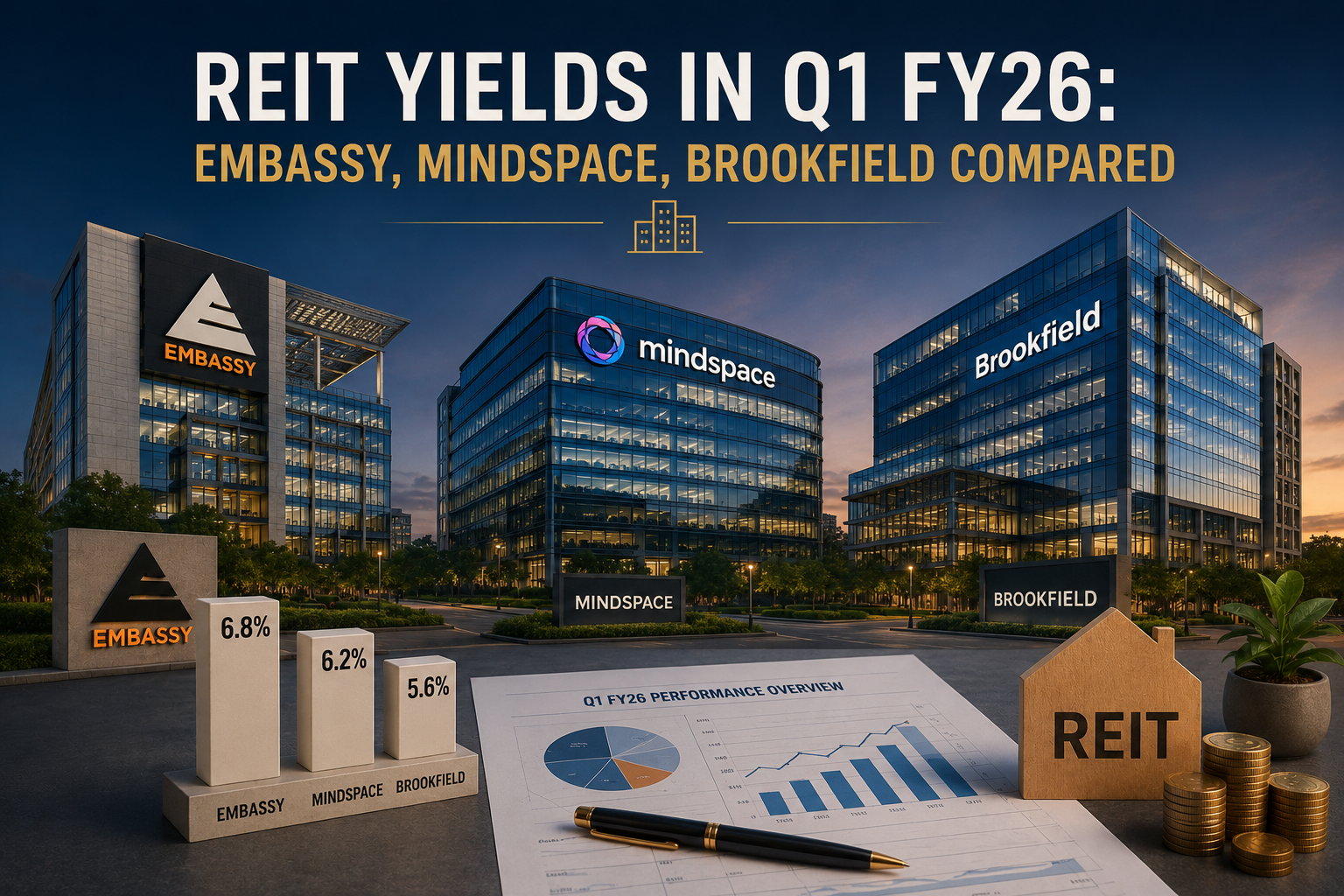
Distribution yields cluster between 6.8% and 7.4%, narrower than the spread we saw a year ago. Occupancy is the differentiator — Mindspace at 89%, Embassy at 86%, Brookfield at 91%.
The lease-expiry tail
The three REITs face very different FY27 renewal cliffs: Embassy has ~12% of GLA expiring, Mindspace ~9%, Brookfield only ~4%. That gap is the single biggest forward-looking variable.
Why occupancy drives the yield gap
A REIT's distribution is funded by rent, so occupancy is the lever that matters most. A few points of occupancy difference compounds: it changes both the rent collected today and the negotiating leverage on renewals. When a building is near-full in a tight micro-market, the landlord can push rent reversions higher; when it has vacant floors, every renewal becomes a defensive conversation. That dynamic, more than headline yield, separates the three trusts.
Judging the quality of a distribution
Two REITs can show the same yield with very different durability. Look past the headline number at how the distribution is composed — the split between genuine rental cash flow, interest, and return of capital — and at the cost and maturity of the trust's debt. A high yield propped up by cheap debt that is about to reprice in a higher-rate environment is more fragile than a slightly lower yield backed by long leases and termed-out borrowing.
What to watch through FY27
- Lease expiries — the renewal cliff above is the biggest swing factor for forward income.
- Rent reversions — whether expiring leases re-sign above or below in-place rents.
- Interest-rate cycle — REIT units are rate-sensitive; the cost of refinancing debt feeds straight into distributions.
- Acquisitions — accretive asset purchases can lift the distribution, but watch how they are funded.
Frequently asked questions
What is a REIT?
A Real Estate Investment Trust is a SEBI-regulated, listed trust that owns income-producing real estate (typically Grade-A offices). It is required to distribute at least 90% of its net distributable cash flow to unitholders, giving investors rental-style income without owning property directly.
What is the difference between a REIT and an InvIT?
Both are listed, yield-paying trusts, but REITs hold real estate (offices, malls, warehouses) while InvITs (Infrastructure Investment Trusts) hold operating infrastructure such as roads, power transmission lines and telecom towers.
What are SM REITs?
Small and Medium REITs are a SEBI framework (notified in 2024) for trusts holding smaller asset pools — broadly ₹50–500 crore in value — with a minimum investment of around ₹10 lakh. They formalise what fractional-ownership platforms were previously doing.
How are REIT distributions taxed?
REIT payouts can be a mix of dividend, interest, rental income and return of capital, and each component is taxed differently in the investor's hands. The blended effective rate depends on the mix, so review the trust's distribution break-up each period.
Key terms
- NDCF
- Net Distributable Cash Flow — the cash a REIT/InvIT is required to pay out (at least 90%) to unitholders; the basis of the distribution yield.
- Distribution yield
- Annual distribution per unit divided by the unit price — the headline income return investors compare across REITs.
- Occupancy
- The share of leasable area that is currently let. Higher, stable occupancy supports more reliable distributions.
- GLA
- Gross Leasable Area — the total floor area available to lease, used to size a REIT's portfolio and measure lease expiries.
- WALE
- Weighted Average Lease Expiry — the average remaining lease term across tenants; a longer WALE means more visible future income.